

How Change Machines Increase Revenue in Self-Service Laundries
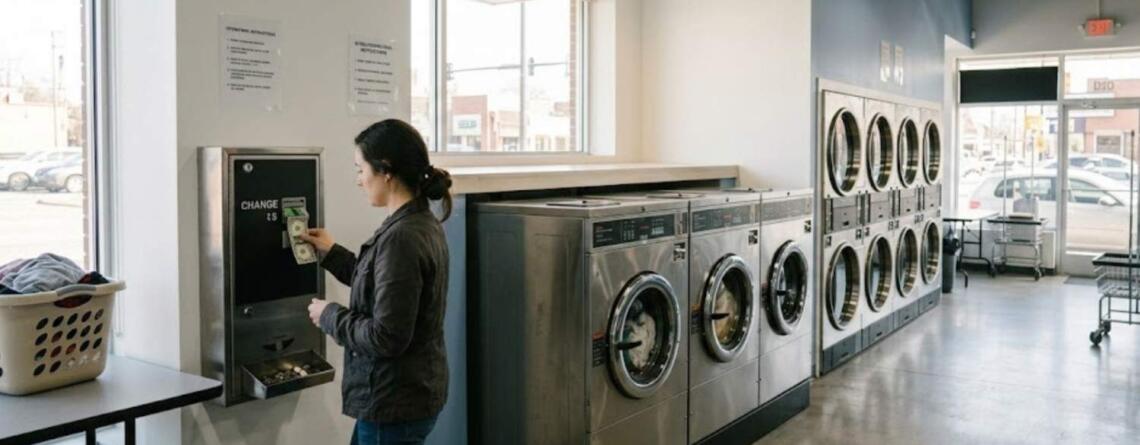
A change machine is not an amenity. It sits against your back wall, converting bills into cycles. The moment yours fails, or you skip installing one, you risk losing sales that never show up on a report.
This guide breaks down how a reliable change machine supports revenue, protects margins, and fits into the modern self-service laundry payment mix.
The Revenue You Risk Losing Without a Change Machine
Lost transactions never appear in your daily totals. That is why most owners underestimate the gap.
The cost of no change is largely invisible. It compounds in any store that still accepts coin payments for some or all of its machines.
Payment friction shows up in three connected ways:
- Walk-aways: A customer with laundry and a $20 bill needs to break that bill. If your store cannot, they often head to the laundromat down the street and may not come back
- Shorter visits: Customers who have to hunt for change tend to wash the bare minimum. Instant coin access removes a small but real barrier to running a second or third load
- Slower cycle starts: Hunting for change can take 5-10 minutes. A bill-to-coin converter starts the wash in under 30 seconds, which compresses peak-hour throughput
Operators who add a working change machine, upgrade older units, or broaden payment access often report meaningful revenue lifts. The size of the lift varies. Store mix, location density, and prior equipment all play a role, and the pattern is directional rather than guaranteed.
Most gains come from three places working together:
- Recovered walk-aways
- Longer visits per customer
- Faster cycle starts during peak hours
Reliable bill-to-coin conversion helps stores capture existing demand more consistently. That consistency adds up across a year of foot traffic.
How a Change Machine Supports 24/7 Unattended Revenue
Many newer self-service laundries are moving toward unattended or hybrid-attended models. These stores often still accept coins for some or all of their machines. That makes the change machine core infrastructure rather than a convenience.
Why Cash Access Matters in Coin-Dependent Unattended Stores
In coin-dependent unattended stores, a failed changer can severely disrupt overnight revenue. Customers cannot start cycles. Washers and dryers sit idle. Competing stores collect the traffic.
Operators running hybrid setups with card systems are less exposed. They still lose the cash-paying segment of their customer base when the changer is down.
Most unattended operators treat the change machine as equipment that has to be monitored, not just installed. That is why remote diagnostics and low-coin alerts are now standard features on newer models.
Read More: How to Maintain and Clean Your Coin Laundry Machines for Long-Term Use
Capturing Off-Peak Cycles
Shift workers, parents of young kids, and apartment dwellers do laundry at unusual hours. Stores with reliable change access stay open to revenue during late-night and early-morning traffic.
These off-peak windows often have less competition. Per-customer revenue can exceed midday traffic.
Reducing Time Spent on Cash Handling
In attended stores, every minute a staff member spends making change is a minute not spent on cleaning, folding, or fluff-and-fold orders. Automated change shifts payroll dollars toward higher-value work.
In fully unattended stores, it eliminates the need for staff to handle cash.
This is where the change machine often justifies itself a second time. Even when the revenue lift is modest, the labor reallocation tends to free up real hours each week.
Customer Experience and Retention Effects
Revenue is not only about today’s transactions. It is about next week’s return visit.
Change machines play a quiet role in retention. They remove one of the more common reasons customers switch laundromats.
The “Out of Change” Sign Is a Loss Event
When a customer sees a handwritten “Out of Change” sign taped to the wall, they often leave for the day. They may also mark your store as unreliable.
Smart change machines now send low-coin inventory alerts directly to owners’ phones. You can refill before the hopper empties.
That alone does not guarantee retention. It eliminates a preventable reason customers walk away.
How Coin Infrastructure Fits Alongside Cashless Payment
Cashless adoption is rising fast in urban laundromats. Card readers, app-based systems, and reload cards are now common.
The role of the change machine has evolved alongside the rise of cashless payment systems. It still anchors the cash side of most stores.
Most laundromats operate in a mixed-payment environment:
- Cash-preferring and unbanked customers still make up a meaningful share of traffic in many neighborhoods
- Legacy coin-operated washers and dryers often stay in service long after the front-of-house adds card readers
- Hybrid setups rely on the changer as a fallback when the card system goes offline or a card declines
In mixed-payment stores, the changer remains operationally important.
Why Changer Condition Affects Store Perception
Customers form impressions quickly. A clean, working change machine signals that you maintain the place.
A broken or boarded-up one signals neglect. Customers extend that judgment to your washers and dryers.
The changer is one of several trust signals. Cleanliness, machine uptime, lighting, and security all reinforce the same impression.
Operational Protections That Defend Your Margins
Top-line revenue matters. So does protecting what you keep.
Modern change machines come with data and security features that defend margins long after the install.
Real-Time Data and Remote Fault Diagnosis
Smart changers give owners visibility into transaction volume, peak hours, and denomination flow. You can adjust marketing, staffing, and refill schedules based on actual numbers rather than guesses.
Remote fault diagnosis is the underrated feature. When the machine throws an error code, you get notified instantly. You can dispatch a fix before the store sits idle for a full shift.
Pair this with a clear plan to replace or repair aging laundry supplies and equipment to keep downtime low.
Read More: When to Replace vs. Repair Laundry Vending Equipment
High-Capacity Hoppers Reduce Refill Trips
Commercial-grade changers Sudsy carries hold roughly 4,200 to 11,200 quarters per hopper, depending on the model and whether the unit runs single- or dual-hopper configurations. Higher capacity means:
- Fewer refill runs per week
- Less time moving cash
- Reduced exposure during transfers
For multi-location operators, this translates into real labor savings. Pairing a high-capacity changer with a coin sorter for end-of-shift counting further compresses cash-handling time.
Security Considerations for Unattended Sites
Unattended laundromats are theft-sensitive businesses. The change machine is often the highest-value target on the floor.
A complete security approach goes beyond the machine itself:
- Anchoring: Floor-bolted or wall-mounted installations make smash-and-grab attempts significantly harder
- High-security cabinets: Reinforced steel housings and pry-resistant doors slow forced entry
- Modern bill validators: Reject counterfeits and worn notes that older changers would accept
- Surveillance integration: Cameras positioned to capture the changer face and approach paths deter attempts and support insurance claims
- Collection protocols: Varied collection times, two-person pickups for high-volume sites, and avoiding visible cash transport reduce risk
- Insurance review: Confirm your policy covers cash-on-premises and equipment damage from theft attempts
Premium models like the Rowe BC-3200RL include high-security bill recyclers built for overnight operation. The cabinet is only one piece of the protection plan.
Standard and Rowe Change Machines Available at Sudsy
Once coin infrastructure makes sense for your store, the next question is which machine fits. The right choice depends on volume, layout, operating hours, and the location’s exposure to theft risk.
Buying Criteria Worth Understanding First
A few specs drive most decisions:
- Rear-load vs. front-load: Rear-load cabinets open from the back wall, keeping service and cash collection out of customers’ view. Front-load models suit tight floor plans where wall access is not possible
- Bill recycler vs non-recycler: A recycler reuses incoming bills as outgoing change. This extends the time between refills, reduces operator labor, and shortens cash-handling cycles
- Single vs dual acceptor: Dual-acceptor units handle two bill streams in parallel, which prevents bottlenecks during peak hours in high-traffic stores
- Hopper capacity: Larger hoppers (closer to 30,000 coins) cut refill frequency in high-volume locations. Smaller hoppers work fine for low-volume sites
Store Type to Recommended Configuration
| Store Type | Recommended Configuration | Example Models |
| Low-volume / apartment laundry rooms | Compact mini-changer | Standard MCM100 |
| Mid-volume attended or hybrid stores | Rear-load with a single acceptor | Standard MC200, MC300RL |
| High-volume stores running long hours | Rear-load with dual acceptor | Standard MC400RL, MC500RL DA, MC700 |
| High-volume 24/7 stores | Dual-acceptor rear-load | Standard MC620RL DA, MC820 DA |
| Unattended overnight / high-theft locations | Hi-security with bill recycler | Rowe BC-1600RL, BC-3200RL |
| Tight floor plans with wall constraints | Front-load with a bill recycler | Rowe BC-1500FL |
Standard Change-Makers: MC Series
Standard’s MC series is the workhorse line for self-service laundries. Sudsy carries the full lineup:
- MC100 and MCM100 mini-changer: Compact installs for small stores or apartment laundry rooms
- MC200 and MC300RL: Mid-volume stores running attended or hybrid models
- MC400RL, MC500RL DA, and MC700: Mid-to-high-volume sites needing rear-load access or heavy-duty single-bill capacity
- MC620RL DA and MC820 DA: Top-tier dual-acceptor, rear-load units built for high-volume 24/7 stores
Standard machines are available with Mars, Coinco, or Pyramid bill acceptors, depending on the model. You can match the validator to your customer base and existing infrastructure.
Rowe Bill Changers with Hi-Vis Bill Recyclers
Rowe changers carry hi-visibility bill recyclers and rear-load security features that suit unattended and high-theft-risk locations:
- BC-1500FL: Front-load option for tight floor plans
- BC-3200RL: Premium tier with hi-security bill recycler for overnight unattended operations
Installation, Placement, and Ongoing Care
Buying the right machine is half the decision. Installing it correctly and keeping it running shapes the actual return.
Installation Requirements to Plan For
A few practical checks before you order:
- Electrical: Most commercial changers run on a standard 120V outlet. Confirm the outlet is on a dedicated circuit and within reach of the planned location. Older buildings may need an electrician to add or relocate an outlet
- Floor space and clearance: Allow enough clearance in front of the machine for customers to load bills and collect coins comfortably. Plan a clear path that does not block the washer or dryer access
- Wall access for rear-load units: Rear-load cabinets require service access through the back wall. If your floor plan has no usable back wall, choose a front-load model.
- Anchoring surface: Confirm the floor or wall can support floor-bolted or wall-mounted installation. Concrete slab is ideal. Wood subfloors may need reinforcement
- Lighting and sightlines: Position the machine where customers can read the bill slot clearly and where surveillance cameras can capture the face of the unit
Where to Position the Changer in Your Store
Placement affects both usage and security. A few principles:
- Near the entrance, but not blocking it: Customers should see the change machine within the first few seconds of walking in. A unit hidden in a back corner gets used less and prompts more “do you have change?” questions in attended stores
- Within sight of the washers: Customers should be able to glance from the washers to the changer without crossing the store. Short paths increase repeat use during the same visit
- Away from water exposure: Keep the unit clear of mop sinks, water heaters, and washer overflow zones. Moisture damages bill validators and coin mechanisms
- In the camera’s field of view: Surveillance coverage of the changer face and approach paths deters theft and supports insurance claims
- Accessible for service and refill: Rear-load units need back-wall clearance for technicians. Front-load units need enough working space in front for hopper service
Ongoing Maintenance at a Glance
Routine care is light, and most of it happens during your normal collection visits:
- Bill validator cleaning: Wipe the bill path every few weeks with a validator cleaning card or lint-free cloth. Dust and worn-note residue cause most rejection issues
- Hopper checks: Inspect coin levels at each refill and watch for jams. Top off before the low-coin alert fires whenever possible
- Cabinet inspection: Check locks, hinges, and anchoring quarterly. Any sign of pry damage warrants immediate hardware review
- Software and acceptor updates: Modern validators occasionally need firmware updates as new bill designs enter circulation. Confirm with your supplier when a refresh is due
- Annual professional service: A yearly checkup catches worn rollers, aging belts, and board-level issues before they cause downtime
What Operators Should Expect Financially
A few practical points to set expectations:
- Entry-level mini-changers suit low-volume locations and sit at the bottom of the price range
- Mid-tier rear-load models carry a mid-range price that varies by acceptor type and configuration
- Premium hi-security bill recyclers sit at the top of the range. Payback is often justified faster in high-volume or unattended stores
- Maintenance is modest in year one and rises as bill validators age. Plan for periodic validator cleaning, hopper service, and occasional board replacement
- Refill frequency depends on traffic and hopper capacity. Most operators settle into a weekly or twice-weekly refill rhythm
Payback timelines vary. Many operators aim to achieve a return on a mid-tier installation within the first year of consistent operation. High-volume or coin-dependent unattended stores tend to recover faster, since recovered transactions are larger and more frequent.
Start Recovering the Revenue Lost to Payment Friction
A reliable payment setup helps recover revenue currently being lost to friction at the point of sale. For most laundromats running coin equipment, that setup still includes a working change machine.
Sudsy stocks Standard and Rowe change machines along with replacement parts, hoppers, bill validators, and cabinets to keep your existing changer running. Our product line includes supplies for coin vending machines, signs, storage solutions, laundry carts, and more.
Installation timelines do not drag on freight from out of state. The right payment setup removes a preventable source of friction that quietly affects revenue, customer retention, and day-to-day operations.
Ready to order? Contact our team for pricing, availability, and a SoCal delivery quote







LEAVE A COMMENT
You must be logged in to post a comment.