
How to Reduce Service Calls in Coin-Operated Laundries
Every emergency repair costs you twice. You pay the technician, and you lose the cycles that the machine should have run while it sat dark. Most owners accept this as the cost of running a laundromat, but a large share of those calls are preventable with a simple operational plan.
Cutting call volume comes down to four pillars: scheduled maintenance, machine data tools, customer-facing operations, and a parts pipeline that keeps the plan supplied. This guide covers each one in plain terms, with specific tasks you can start using this week.
Why Service Calls Drain Your Margin
A service call is rarely just the invoice from the technician. The higher cost shows up as lost cycles, customers who try a different store and stay there, and accelerated wear on the machines that pick up the slack.
Reactive repairs also cost more per visit. After-hours and same-day labor rates are noticeably higher than scheduled service rates. When two or three machines display out-of-service tags on a busy weekend, regulars start driving elsewhere, and many do not return. Service call volume is one driver of profit, not the only one, but it is one of the few drivers you can directly control.
Pillar One: Build a Proactive Maintenance Routine
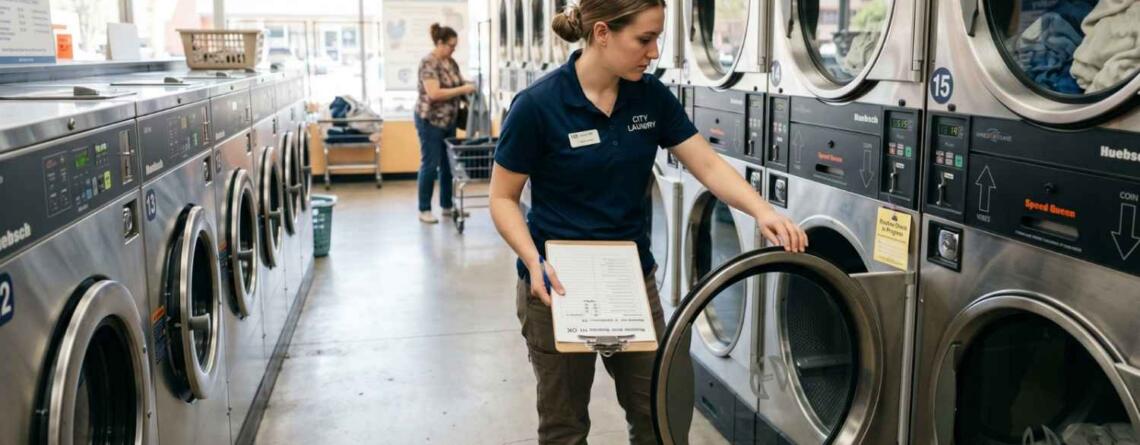
Scheduled inspections catch wear early, when fixes are cheap and fast. The goal is to spot a cracking hose before it splits, not to mop the floor after it does. A consistent cleaning and maintenance routine builds the foundation for everything else.
Read More: How to Maintain and Clean Your Coin Laundry Machines for Long-Term Use
Daily Walkthroughs
A five-minute morning walkthrough catches the most common call triggers before customers report them.
- Coin slots and bill acceptors: Clear lint, debris, and sticky detergent residue from slot paths. Buildup here drives the majority of “machine is broken” calls that turn out to be a payment jam.
- Door seals and gaskets: Wipe rubber seals and check for cracking, mildew, or stretched edges. A failing seal becomes a leak call within weeks.
- Lint screens: Pull, clear, and reseat. Clogged screens force dryers to run hotter and longer, shortening heating element life and triggering “won’t dry” complaints.
- Drum interiors: Look for coins, hairpins, and stray hardware before first cycle. Loose metal in the drum is a top cause of mid-cycle stoppage calls.
- Door latches and strikes: Push-test each door. A misaligned strike reads to the customer as a locked or broken machine.
- Floor near machines and drains: Standing water signals a slow leak or pump issue. Catching it dry is a 10-minute fix; catching it wet is a flood call.
Log anything addressed during the walkthrough so patterns surface in the maintenance log over time.
Weekly Inspections
Weekly checks catch the slower failures that daily walkthroughs miss. These are the ones that flood your floor when ignored.
- Hose condition: Check washer fill hoses for bulging, kinking, or surface cracks. Replace at the first sign of wear.
- Hose clamps and fittings: Loose clamps account for a significant share of “machine flooding” calls that turn out to be a 30-second tightening fix.
- Drainage: Standing water near a machine signals a slow leak or a failing pump, which can become a flood call within weeks.
- Door boots: Look for hairline cracks at the bottom curve where water pools.
The split between daily and weekly tasks matters. Daily checks cover the high-touch points customers interact with. Weekly checks cover the slower-moving wear that does not show up in surface inspection.
Track Each Machine in a Simple Log
Memory is the worst maintenance system. A spreadsheet or paper log shows which machines repeatedly cause problems and which run clean.
For each event, record the machine number, date, issue, part replaced, and labor cost. After three months, the repeat offenders become obvious. A washer that has required four motor visits in six months is no longer a candidate for repair. Use the log when deciding whether to repair or replace a unit, so the call is grounded in cost-per-cycle rather than gut feel.
Read More: When to Replace vs. Repair Laundry Vending Equipment
Train Attendants to Execute the Routine
A maintenance plan only works if the people running your store know exactly what to do. Walk new attendants through the daily and weekly checklists on their first shift. Post a laminated copy near the back office. Spot-check execution once a month by reviewing the log against the actual condition of seals, hoses, and slots. A routine that lives only in the owner’s head fails the moment the owner takes a day off.
Pillar Two: Use Machine Data to Catch Failures Early
Newer washers and dryers track operational data that your eyes cannot see. If your fleet supports it, this data turns guesswork into early warning.
What Machine Data Can Tell You
Connected equipment can flag patterns that point to coming failures. A bearing on its way out generates a vibration signature before it seizes. A heating element losing efficiency shows up as a longer dry cycle before customers complain. A motor running hot reveals itself in temperature logs days before it stops.
This capability depends on having connected equipment. Older coin-only fleets without onboard sensors will not deliver this data, and retrofitting is rarely cost-effective. If you operate newer machines, look for a monitoring platform that integrates with your equipment brand, sends real-time alerts to your phone, and keeps the dashboard simple enough for an attendant to read.
Tune Cycle Settings to Reduce Strain
Default factory cycle settings are calibrated for an average store, not yours. Tuning the programmable parameters on each machine reduces the mechanical strain that produces repair calls.
- Tighter unbalanced load detection: Rejects bad loads earlier and prevents the violent spin failures that crack mounts, snap belts, and walk machines out of position.
- Right-sized water fills: Match fill volume to load capacity so solenoids and pumps stop short-cycling. Oversized fills are a leading cause of premature solenoid failure on high-volume machines.
- Wash-phase tuning: Longer wash times at lower agitation levels typically outperform short, aggressive cycles on both wash quality and motor wear, per most front-load manufacturer guidelines. Consult your equipment manual for recommended ranges.
- Spin ramp-up curves: Gradual spin acceleration reduces bearing stress compared to default high-torque ramps. Bearing replacement is one of the costliest repair calls in the fleet.
- Hard-water adjustments: In hard-water regions, increase rinse cycles by 10–20% to prevent detergent residue buildup that fouls valves and triggers complaints about “machine smells”.
Document every setting change in the maintenance log so the impact on call volume is measurable over the next 60–90 days.
Schedule Service During Slow Hours
Once alerts are reaching your phone, you can stop reacting and start scheduling. When the system flags a developing motor issue on a Tuesday, you book the visit for Wednesday at 9 AM, your slowest hour. The machine never goes fully out of service, customers never see a closed sign, and you pay standard labor rates instead of emergency premiums.
Pillar Three: Reduce Customer-Caused Downtime
A real share of service calls is not equipment failures. They are payment confusion, overloaded drums, or impatience over a normal cycle finishing slightly later than the customer expected. Three operational fixes cover most of these calls.
Clear Signage Above Every Machine
Most laundromats undersell signage. Customers blame the machine when they overload it, and you get the call. Visual signage above each machine bank prevents that.
- Load capacity diagrams: Visual fill lines work better than text-only weight limits.
- Sort guidance: Color, fabric, and load weight basics reduce calls about uneven loads.
- Bilingual coverage: English and Spanish reflect the customer base in most Southern California stores and prevent miscommunication-driven calls.
- Out-of-order tags with a phone number: Direct contact resolves issues faster than a generic notice. Sudsy carries bilingual out-of-order tags in red and blue, English-only or English-Spanish. See other coin laundry signage in Sudsy’s coin laundry supplies catalog.
Diversify Payment Beyond Coin
Coin-only payment carries built-in mechanical risk. Bent quarters, foreign coins, and lint buildup cause rejections that customers report as broken machines.
A card or app reader as a secondary payment path keeps revenue flowing when a coin acceptor jams. Owners keeping coin payment as a primary option benefit from reliable Standard and Rowe change machines, with full Standard parts inventory available for service. For soap dispensing on the customer floor, Sudsy carries both Vendmaster and Vision vender lines, including a debit-capable Vision soap debit vender for stores reducing coin reliance.
Show Customers the Cycle Status
Customers ask if a machine is broken because they cannot tell. A simple in-store screen showing which washers are running and how many minutes remain cuts status-related calls to near zero. App-based timers that ping a phone when a cycle finishes reduce the foot traffic that distracts attendants from real issues.
Pillar Four: Keep Your Parts Pipeline Ready
A maintenance plan only works when the parts arrive in time to use them. The fastest inspection routine in the world means nothing if the replacement hose ships in seven business days.
Stock the Parts You Replace Most Often
Keeping a small on-site inventory turns a two-day repair into a 20-minute swap. Most of these items live in Sudsy’s coin laundry supplies catalog, and the list is shorter than most owners expect.
- Hoses: Washer fill hoses in the sizes and lengths your machines use, including stainless-braided options for high-pressure applications.
- Door seals and gaskets: Brand-specific replacements for your washer fleet.
- Coin acceptor parts: The small components inside the slot mechanism that wear out fastest, including spring kits and cleaning supplies.
- Soap vender wear parts: Replacement parts for Sudsy’s Vendmaster soap venders, including flipper springs covering 294, 394, 494, and 894 models, plus security straps, coin boxes, and replacement doors.
- Change machine essentials: Bill stacker belts and replacement boards for Standard units.
Pair the inventory with an organized supply room so attendants can find the right part in seconds, not 15 minutes of digging.
Read More: Best Practices for Organizing Your Laundromat Supply Room
SoCal Truck Delivery for the Parts You Cannot Stock
Some parts are too expensive or too specific to keep on the shelf. Full PCB assemblies and distribution boards for Standard change machines are a good example. For Southern California operators, freight from out-of-state suppliers turns a one-day fix into a one-week outage.
Sudsy’s truck routes serve Los Angeles, Ventura, Orange, Riverside, San Bernardino, and San Diego counties directly, which keeps regional delivery faster than national freight on most orders. That is the operational logic behind Sudsy’s nery, so you are not waiting on a single bulk order while machines sit dark.
Where to Start
If you are tackling this for the first time, work in this order rather than launching all four pillars at once.
- Start with the daily walkthrough. It costs nothing and catches the most common call triggers within a week of consistent use.
- Add the maintenance log next. Two months of data tells you which machines deserve repair budget and which deserve replacement.
- Stock your top wear parts. Hoses, seals, and the most common change machine and Vendmaster vendor parts cover the majority of repair scenarios.
- Layer in customer-facing fixes. Signage and payment diversification reduce the user-error calls that masquerade as equipment failures.
- Add machine monitoring last, and only if your equipment supports it.
Each pillar reduces call volume on its own. Together, they stabilize day-to-day operations and keep more machines generating revenue. To put the plan into action, contact Sudsy and explore our full range of parts, vending machine supplies, change machine components, and laundromat essentials, available with fast, reliable delivery so you can fix issues before they turn into service calls.
Issue: Sudsy’s live homepage lists shipping options as “Pallet Loads,” “Next-Day Air,” and “Second-Day Air” — these are air-freight options, not regional truck routes. The blog’s “next-day vending supply delivery” via SoCal trucks is not a published service tier on the live site. Verify with client before publication or rephrase to “fast regional truck delivery” to match the live language (“our trucks are equipped and ready to deliver when and where you need them”).









LEAVE A COMMENT
You must be logged in to post a comment.